
Radio Codes Trainer
Learn the radio talk most GTA roleplay servers use, from 10-4 to Code 3.
Loading your friend’s challenge…
Radio Codes Trainer
Flip through the codes, mark the ones you know, then try a Drill.
0 of 69 marked as known.
Ready? 60 seconds, as many as you can.
Spell this callsign in phonetic words: 4-A-12
Streak 0
Today's Daily Drill: 10 questions, the same for everyone.
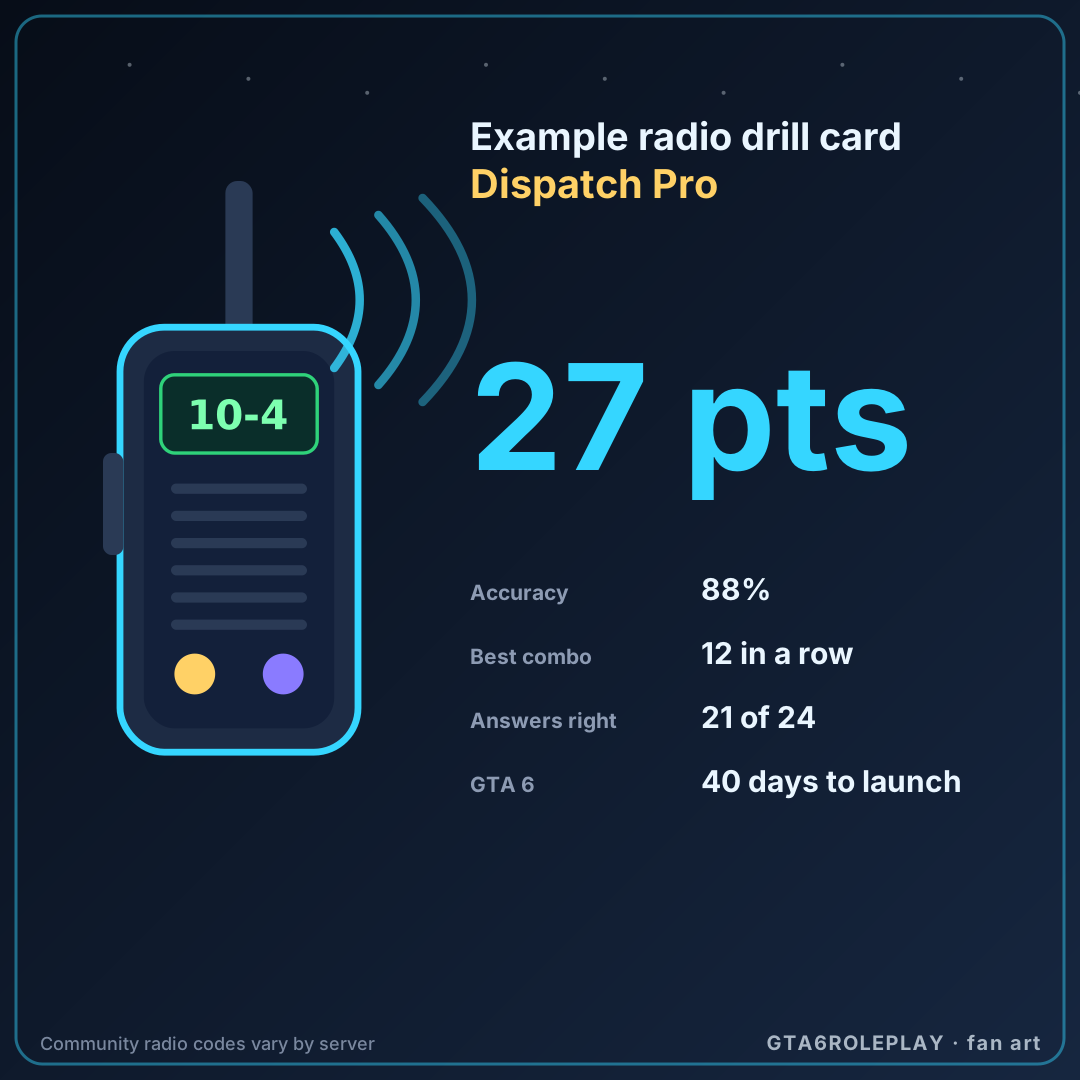
Add the phonetic alphabet, then race the clock in a 60-second drill. A daily round, personal bests and a score card to share. These are common community conventions that vary by server, not official Rockstar or in-game codes.
The codes
These are the codes and phrases you are most likely to hear on GTA roleplay servers. They are common community conventions, written here in our own words; your server's list may differ.
Basics
- 10-4
- Message received and understood.
"10-4, I'll meet you at the gas station." - 10-1
- Your signal is breaking up.
"10-1, you're cutting out. Move to higher ground and try again." - 10-9
- Repeat your last message.
"10-9 on that plate? I only caught the first letter." - 10-20
- Where are you right now?.
"Unit 12, what's your 10-20?" - 10-22
- Ignore my last message.
"10-22 that last call, the caller says it was a false alarm." - 10-23
- I have arrived on scene.
"10-23 at the pier, starting a walk around." - Copy
- I heard you and I understand.
"Copy, holding position until you get here." - Say again
- I missed that, please repeat it.
"Say again, which street did you say?" - Stand by
- Wait, I will come back to you.
"Stand by, checking that name now." - Over
- I have finished talking, your turn.
"Two suspects heading north on foot. Over." - Affirmative
- Yes.
"Affirmative, the road is clear." - Negative
- No.
"Negative, no sign of the vehicle here."
Police
- 10-8
- In service and free to take calls.
"Unit 4, 10-8 and back on patrol." - 10-7
- Out of service, going off duty.
"10-7 for the night, see you all tomorrow." - 10-6
- Busy right now, not free for calls.
"10-6 on a report, send someone else." - 10-15
- A suspect is in custody.
"10-15 with one, heading back to the station." - 10-31
- A crime is in progress.
"10-31 at the jewellery store, alarm still going." - 10-38
- I am making a traffic stop.
"10-38 on a red coupe, two people inside." - 10-80
- A vehicle pursuit is under way.
"10-80, white van heading for the highway." - 10-13
- An officer needs help urgently.
"10-13! Shots fired, I need units now!" - Code 1
- Respond normally, no lights or siren.
"Code 1 to the noise complaint, take your time." - Code 2
- Respond quickly, lights but no siren.
"Code 2 to the fender bender on Main." - Code 3
- Emergency response with lights and siren.
"Code 3, the caller says someone is hurt." - Code 4
- Scene is under control, no more help needed.
"Code 4, everyone can clear out." - Code 6
- Out of the vehicle, checking on foot.
"Code 6 at the parking lot, checking the cars."
EMS
- 10-52
- An ambulance is needed.
"10-52 to the intersection, one person down." - Bus
- Slang for an ambulance.
"The bus is two minutes out." - Staging
- Waiting nearby until the scene is safe.
"Medic 2 staging a block away until police clear it." - Triage
- Sorting patients by how urgent they are.
"Three patients, starting triage now." - Transporting
- Taking a patient to the hospital.
"Transporting one, stable, to the hospital." - Stable
- The patient is not getting worse.
"Patient is stable, no rush on the way in." - Critical
- The patient is in serious danger.
"Patient is critical, have a doctor ready." - Conscious and breathing
- The patient is awake and breathing.
"Conscious and breathing, complaining of a sore arm."
Dispatch
- Show me en route
- Mark me as on my way to the call.
"Dispatch, show me en route to the bank." - 10-3
- Stop talking, keep the channel clear.
"All units 10-3, priority call coming through." - 10-28
- Check who a vehicle plate belongs to.
"Run a 10-28 on plate Kilo X-ray Tango." - 10-29
- Check a person or plate for warrants.
"10-29 on that driver, please." - BOLO
- Be on the lookout for someone or something.
"BOLO for a green pickup with a broken light." - Priority traffic
- An urgent message is coming, give it the air.
"Priority traffic: a unit is down near the docks." - Go ahead
- I am listening, send your message.
"Dispatch, go ahead for Unit 7." - Requesting backup
- Send more units to my location.
"Requesting backup, the crowd is growing." - 10-51
- A tow truck is needed.
"10-51 for the car blocking the lane." - ETA
- How long until you get here.
"What's your ETA? About three minutes."
The phonetic alphabet
The standard international (NATO) spelling alphabet. Some servers use older police words instead, such as "Adam" for A in a callsign like 4-ADAM-12; the trainer uses the standard words.
- A Alfa
- B Bravo
- C Charlie
- D Delta
- E Echo
- F Foxtrot
- G Golf
- H Hotel
- I India
- J Juliett
- K Kilo
- L Lima
- M Mike
- N November
- O Oscar
- P Papa
- Q Quebec
- R Romeo
- S Sierra
- T Tango
- U Uniform
- V Victor
- W Whiskey
- X X-ray
- Y Yankee
- Z Zulu
Why radio discipline matters in RP
On a busy night a police or EMS channel carries a dozen people at once. Short, clear calls keep everyone in the scene: say who you are, where you are and what you need, then let go of the button. Codes help because they are quick, but only when everyone on the channel knows them, so new players should learn their server's list before their first shift. Keep in-character radio separate from out-of-character chat, and never use the radio to pass on something your character could not know; that is metagaming.
How codes differ between servers
There is no single standard. Real agencies use different 10-codes, many have switched to plain speech, and RP communities mix and match. On one server 10-38 is a traffic stop, on another it is something else, and some servers ban codes entirely on the main channel. Before your first police or EMS shift, check your server's rules and training channel, and ask a supervisor in character if you are unsure. Read more about police and EMS roles, the rules most servers share and the RP glossary.
Questions
Are these the official GTA 6 radio codes?
No. They are common conventions that many GTA roleplay communities borrowed from real-world radio habits and adapted. Every server has its own list, and some use plain speech instead. Nothing here is from Rockstar or the game. Always learn your own server's codes from its rules or training.
How does the Drill score work?
You have 60 seconds. Each right answer scores one point, multiplied by your combo: 2x after 4 right in a row, 3x after 8, 4x after 12. A wrong answer resets the combo but not your points. Your best score, accuracy and longest combo are kept in this browser and shown on your file.
What is the Daily Drill?
Ten questions, the same for everyone on a UTC day. Playing it counts as one of today's dailies. Once 20 people have played, you can see how your score compares; before that the page only shows how many have played. Send a friend a link with your score and they can try to beat it.
Why learn the phonetic alphabet?
Letters like B, D and P sound alike over a crackly radio. Saying "Bravo, Delta, Papa" makes plates, names and callsigns clear the first time, which keeps a scene moving instead of stalling on "say again".

Keep exploring
Daily games: 28 pages to explore
- Dispatch DeskTake a dispatcher shift: calls come in, and you send the right unit.
- PartnersA daily classic Dominosa logic puzzle. Pair every officer on an imagined roleplay server's shift board: the cards…
 GTA roleplay glossaryThe words you will hear in any RP city, in three groups: how people play, the tech servers run on, and the rules that…